
Parmenides
Pre-Socratic philosopher who argued reality is one and unchanging.

Plato · Public domain
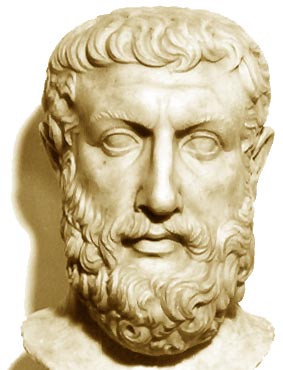
Parmenides of Elea was a pre-Socratic Greek philosopher from Elea in Magna Graecia (Southern Italy). He is considered the founder of ontology and the Eleatic school of philosophy, and through his influence on Plato, he has influenced the whole history of Western philosophy.
- field
- Philosophy
- nationality
- Greek (from Elea, Magna Graecia)
- known_for
- Founder of ontology; Eleatic school; poem On Nature; distinction between truth (Aletheia) and opinion (Doxa)
Lore & Background
Parmenides was born in the Greek colony of Elea to a wealthy and illustrious family. His single known work is a philosophical poem in dactylic hexameter verse, often called On Nature, of which only fragments survive. In it, he prescribes two views of reality: the way of Aletheia (truth), describing reality as one, changeless, and timeless; and the way of Doxa (opinion), describing the deceptive world of appearances. He founded the Eleatic school, which included Zeno of Elea and Melissus of Samos; Zeno's paradoxes of motion were developed to defend Parmenides's views.
Reader's Guide
Parmenides has been considered the founder of ontology, and his work has remained relevant in contemporary debates about the philosophy of time. His distinction between the unchanging truth of reality and the deceptive world of sensory appearances profoundly influenced Plato, and through Plato, the entire subsequent history of Western philosophy. The Eleatic school he founded, with its radical monism, set the terms for later metaphysical inquiry. In contemporary philosophy, his ideas continue to inform discussions on the nature of time and change. His poem, though fragmentary, is remarkably well-preserved compared to other pre-Socratic works, allowing scholars to reconstruct his doctrines with greater precision.
Did You Know?
- Parmenides was born in Elea to a wealthy and illustrious family.
- His single known work is a philosophical poem in dactylic hexameter verse, often called On Nature.
- He is considered the founder of the Eleatic school, which included Zeno of Elea and Melissus of Samos.
- Plato's dialogue Parmenides depicts him visiting Athens at age 65 and meeting a young Socrates.
Aristocratic Origins and the Puzzle of His Dates
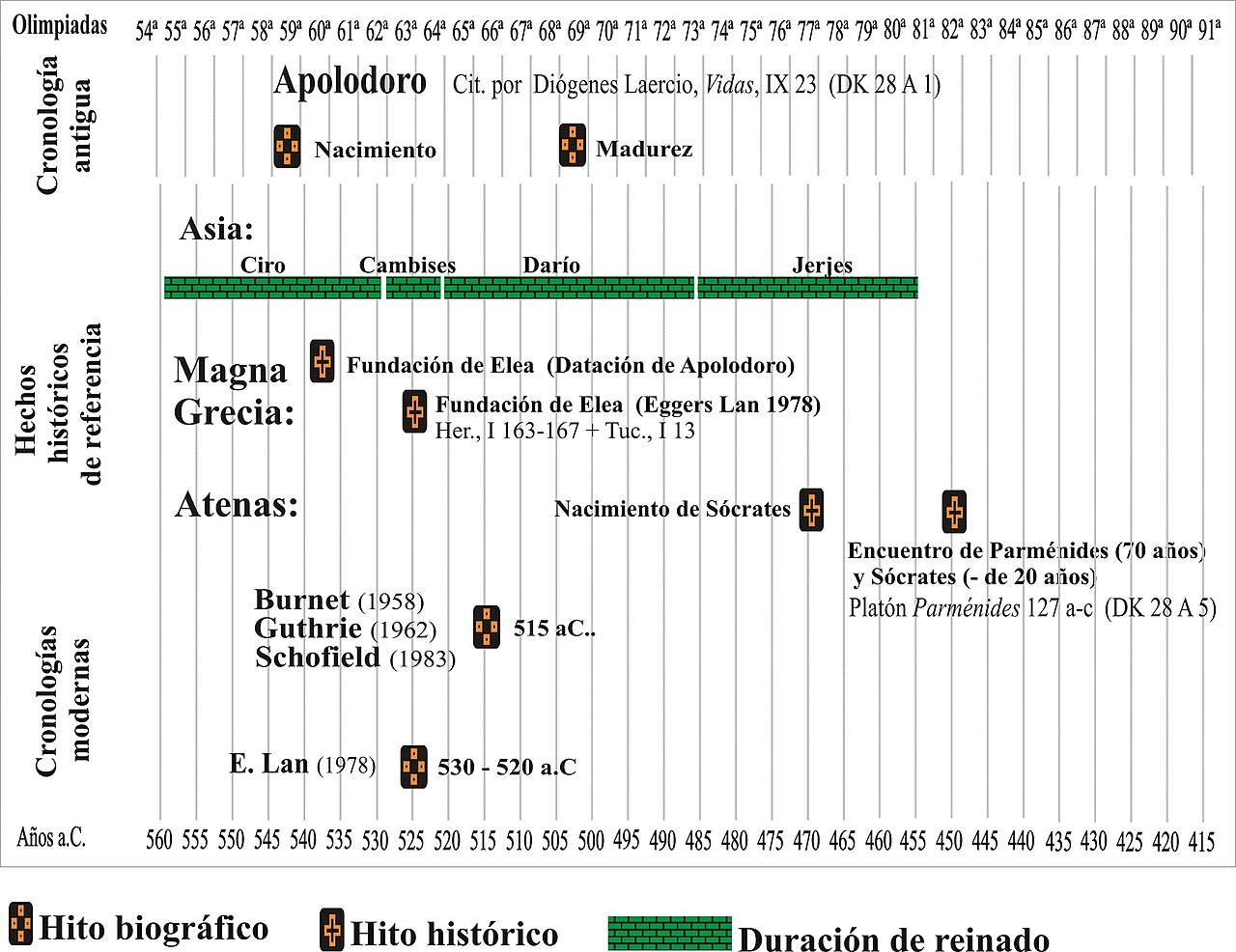
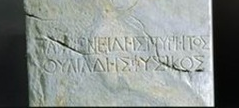
Parmenides was born into a wealthy, illustrious family in Elea, a Greek colony in Magna Graecia (Southern Italy). His father's name, preserved through the doxographer Diogenes Laërtius, was Pires. The philosopher's exact birth year remains one of the enduring puzzles of ancient biography. One tradition, traced back to Apollodorus and transmitted by Laërtius, pegs his maturity to the period just before 500 BC, implying a birth around 540 BC. A very different picture emerges from Plato's dialogue Parmenides, where the philosopher is depicted as a sixty-five-year-old visiting Athens alongside the forty-year-old Zeno, meeting a still-young Socrates. If that scene is taken at face value, Parmenides would have been born closer to 515 BC. Scholars have debated which source to trust. Some, following Burnet and later classicists, lean on Plato's precise age details; others, including R. Hirzel and Conrado Eggers Lan, question whether the Platonic meeting carries any historical weight at all, suggesting it may be a purely literary device. A third approach, drawing on Herodotus and Thucydides, attempts to anchor the date by the founding of Elea itself, yielding a window between roughly 530 and 520 BC.
The Poem and Its Two Paths
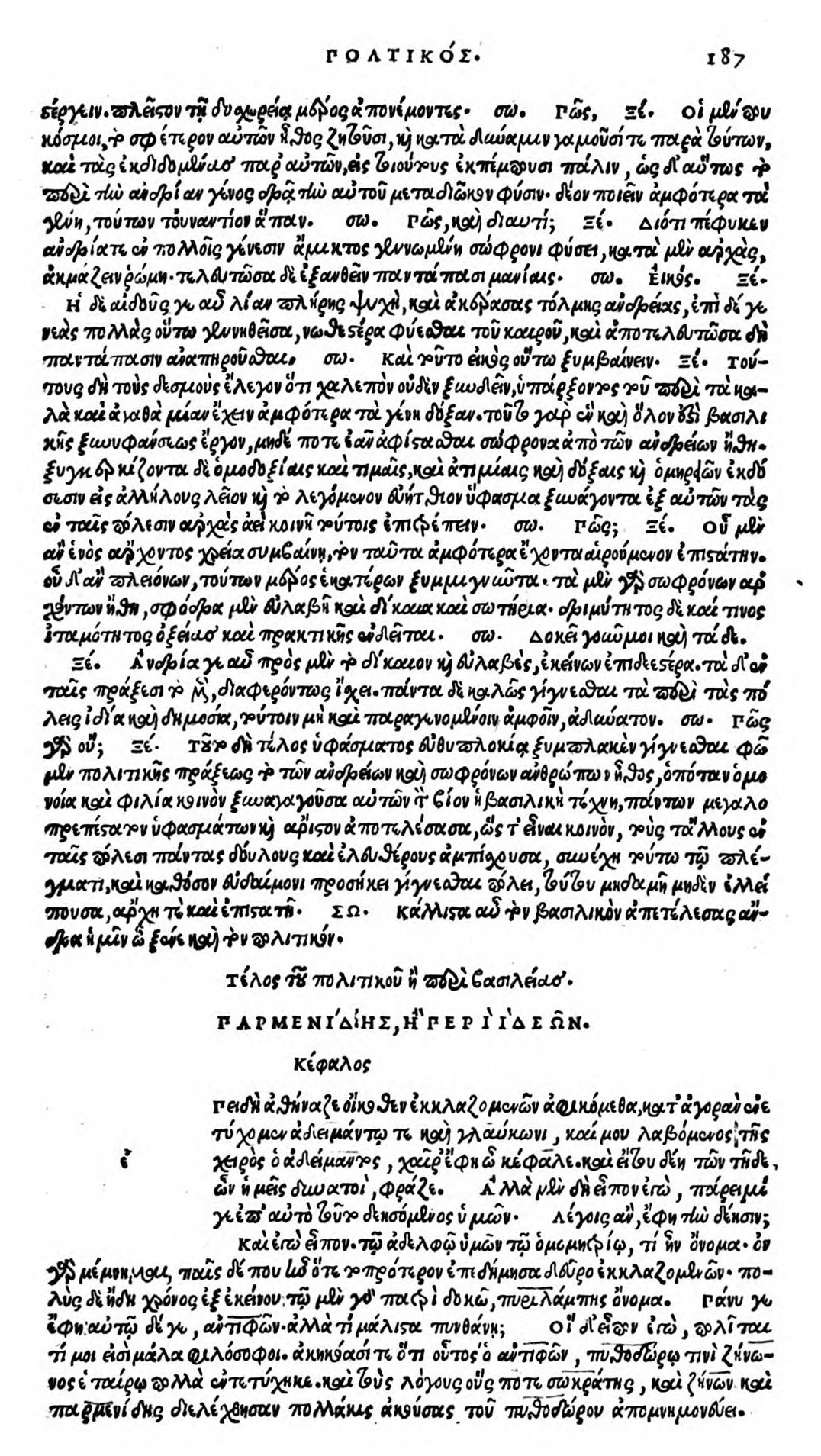
Parmenides left behind a single surviving work: a philosophical poem composed in dactylic hexameter, the same metrical form used in Homer's epics. Its original title has been lost, and modern readers conventionally call it On Nature. What makes this text extraordinary among pre-Socratic writings is the degree to which it has survived. While most of the other thinkers from that era are known only through scattered quotations and secondhand reports, Parmenides' poem retains a remarkable structural integrity, allowing classicists to reconstruct his doctrines with a precision simply unavailable for his peers. At the heart of the poem lie two contrasting paths. The first, called the way of Aletheia or truth, asserts that all of reality is fundamentally one, that genuine change is impossible, and that existence is timeless and uniform. The second, the way of Doxa or opinion, acknowledges the world as it appears to the senses, but insists that what our faculties report is false and deceptive. This sharp division between what truly is and what merely seems became a defining move in the history of philosophical thought.
The Eleatic School and Its Defenders
From his base in Elea, Parmenides established a school of thought that would prove enormously influential. Two figures are most closely associated with this Eleatic tradition: Melissus of Samos and Zeno of Elea. Zeno, described as a close friend of the master, devoted much of his philosophical energy to defending Parmenides' radical claims about the impossibility of change and plurality. His famous paradoxes of motion were crafted specifically to show that the very notion of movement, when subjected to rigorous logical scrutiny, collapses into contradiction. In this way, Zeno's work functioned as a kind of philosophical bodyguard for Parmenides' core theses. The school's reach extended beyond Elea itself; Melissus of Samos carried the Eleatic commitment to the unity and permanence of being into a new geographic and intellectual context. Together, these thinkers formed a coherent tradition that challenged the prevailing Ionian and Milesian accounts of the cosmos, insisting that what the senses present is not the ultimate structure of reality but a misleading surface.
Founder of Ontology and a Lasting Philosophical Presence
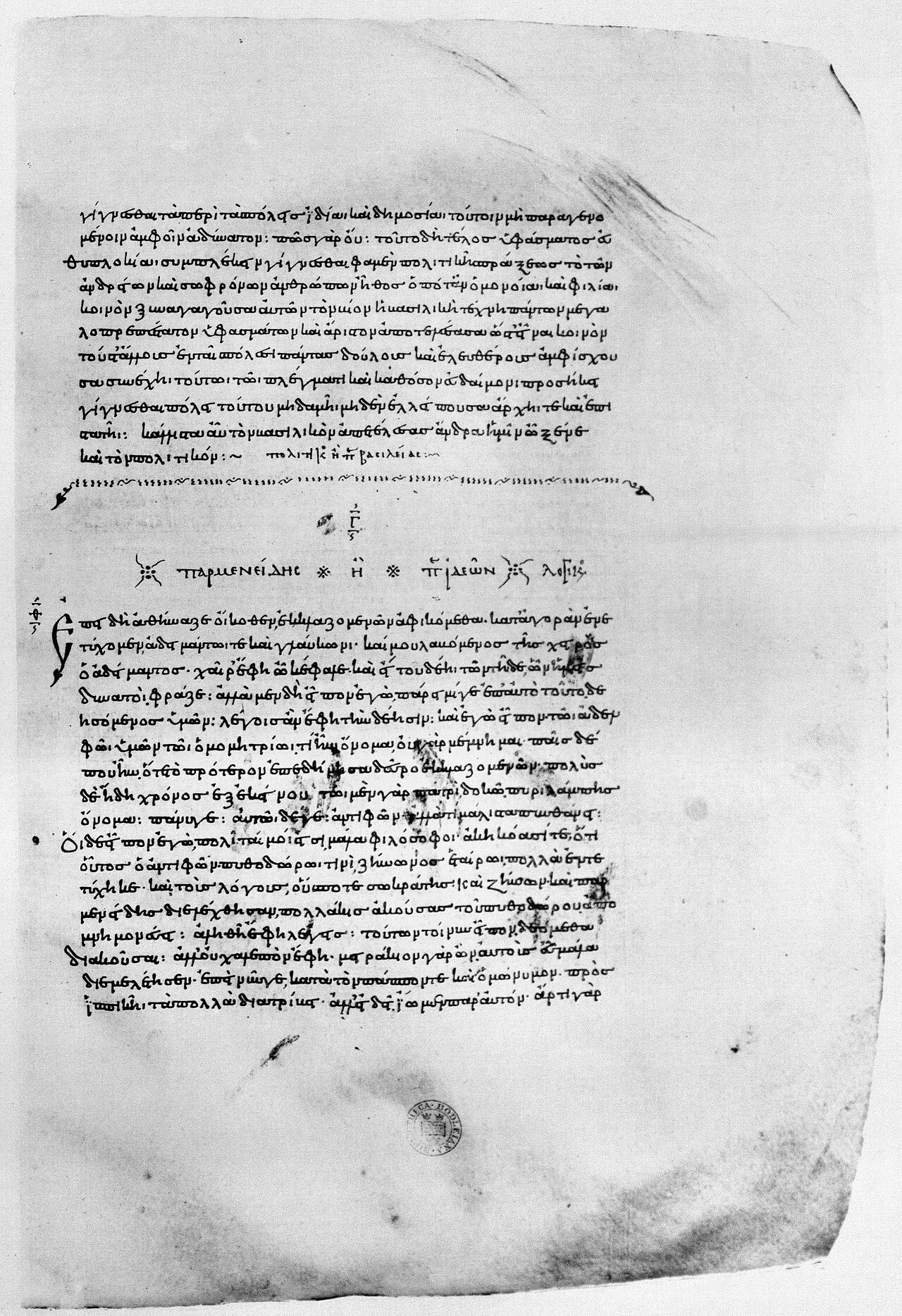
Parmenides is widely regarded as the founder of ontology, the branch of philosophy concerned with the nature and structure of being itself. His insistence that true reality is one, unchanging, and timeless set the stage for questions that have occupied Western thinkers for over two millennia. His influence on Plato is particularly significant: the Athenian philosopher engaged directly with Parmenidean ideas, and through that channel the Eleatic vision permeated the entire subsequent history of Western philosophy. The dialogue Plato composed under Parmenides' name is itself a testament to how deeply the Eleate's thought had penetrated the Platonic project. Even in contemporary philosophy, Parmenides' work continues to generate active debate, particularly in discussions surrounding the philosophy of time. The question of whether time is a fundamental feature of reality or an illusion imposed by human perception echoes the ancient distinction between Aletheia and Doxa. In this sense, a thinker who flourished around 475 BC in a small colony in southern Italy remains a living presence in the most current philosophical conversations.
Gallery

Frequently Asked Questions
Who is Parmenides?
Parmenides was a pre-Socratic Greek thinker who lived in the city of Elea, located in what is now southern Italy. He is traditionally placed in the mid-6th or early 5th century BCE, though scholars still debate his exact birth year.
What is Parmenides's central philosophical claim?
He argued that true reality is a single, indivisible, and utterly unchanging whole, meaning that change, multiplicity, and motion are mere illusions of perception. This radical monism became the defining doctrine of the Eleatic school of thought.
What is the poem 'On Nature' and why does it matter?
It is the sole surviving work attributed to Parmenides, written in verse and split into two major sections: 'The Way of Truth' (Aletheia) and 'The Way of Opinion' (Doxa). The sharp contrast he draws between genuine knowledge and mere appearance became a cornerstone of later metaphysical inquiry.
How did Parmenides influence Plato and the broader Western tradition?
Plato devoted an entire dialogue to a character bearing his name, using Parmenidean ideas as a springboard for his own theory of Forms. More broadly, Parmenides is credited with launching ontology—the study of being as such—making him a foundational figure for virtually every subsequent Western metaphysical tradition.
What school of philosophy is Parmenides associated with?
He is regarded as the founder of the Eleatic school, named after his home city of Elea in Magna Graecia. His student Zeno of Elea later defended Parmenidean arguments against change and plurality, cementing the school's reputation throughout the ancient world.
More in Philosophers And Logicians 1-24
Elsewhere in the Philosophers And Logicians universe
Spotted an error? Know more?
This is a living reference — every entry is fact-audited, and reader corrections feed straight into our audit queue. Suggest an edit · See this site's audit record